Lyocell vs Modal vs Rayon: Drape, Pilling & Price Compared
All three come from wood pulp, but chemistry, drape, and durability split sharply. A wholesale mill explains which cellulose to spec for which end-use.
A buyer in Marseille designing a Spring/Summer 2027 dress line emailed us three different fiber requests in the same week: “Quote me on viscose challis for the breezy maxi, modal jersey for the slip dress, and lyocell for the slow-fashion piece.” Same buyer, same season, three fibers — and she could not articulate to her own factory why she had picked each one.
She is not alone. Most wholesale buyers treat rayon, modal, and lyocell as three slightly different versions of the same thing — “the artificial silk family” or “the wood-pulp fibers.” They do come from the same starting material (cellulose extracted from beech, eucalyptus, or other hardwood pulp), but the manufacturing chemistry that turns pulp into fiber is fundamentally different, and that chemistry shows up in drape, pilling, strength, and price.
If you’ve ever wondered why your lyocell sample feels heavier than your rayon sample at the same GSM, this article is the same chart we walk every new buyer through.
How each fiber is actually made
All three start the same way — wood pulp dissolved into a viscous solution, then extruded through spinnerets to form continuous filaments. The split is in what solvent dissolves the pulp.
| Fiber | Dissolution method | Year invented | Key property delivered |
|---|---|---|---|
| Rayon (Viscose) | Carbon disulfide (CS2) + caustic soda — the “viscose process” | 1894 | Cheap, soft, drapes well — but weak when wet |
| Modal | Same CS2 process as rayon, but with stretched/aligned fibers during spinning | 1960s | 1.5-2× stronger than rayon, especially wet; same hand |
| Lyocell (Tencel) | NMMO (N-methylmorpholine N-oxide) closed-loop solvent — no CS2 | 1990s | Strongest of the three; eucalyptus pulp; closed-loop solvent recycled |
This is why the price ladder is consistent across the wholesale market: rayon < modal < lyocell. The NMMO process is more expensive to run and the closed-loop solvent recovery adds cost, but it eliminates the CS2 environmental load that traditional viscose mills are notorious for.
Side-by-side comparison on the dimensions that matter
| Dimension | Rayon (Viscose) | Modal | Lyocell (Tencel) |
|---|---|---|---|
| Hand feel (dry) | Soft, silky, slight cling | Soft, smoother than rayon | Soft + slight drape weight |
| Drape | Excellent (flowy maxi-friendly) | Excellent, more body | Excellent + slight memory |
| Wet strength | Weak — 40-60% of dry strength | Strong — 75% of dry | Strongest — 85% of dry |
| Pilling resistance | Moderate (shows in 20-30 washes) | Better than rayon | Best of the three |
| Shrinkage (first wash) | 4-7% | 2-4% | 2-3% |
| Dye take-up | Excellent (deep saturated colors) | Excellent | Excellent + slight luster |
| Wrinkle resistance | Poor (needs ironing) | Moderate | Better (slight memory) |
| Wholesale cost | $0.85-1.40/m at 150 m MOQ | $1.40-2.20/m | $2.20-3.50/m |
| Best end-use | Breezy summer dresses, blouses, kaftans | T-shirt jersey, slip dresses, loungewear | Slow-fashion dresses, premium blouses |
| Sustainability claim | Weakest (CS2 emissions) | Same as rayon | Strongest (closed-loop NMMO, FSC pulp) |
The cost spread is real: lyocell typically costs 2-3× rayon at the same GSM and width. If your retail price point doesn’t support that gap, the technically “better” fiber isn’t actually better for your business.
When rayon is the right answer
Rayon (sold as viscose in most non-US markets) is the workhorse of the printed-dress wholesale industry. It earns its dominance through three properties:
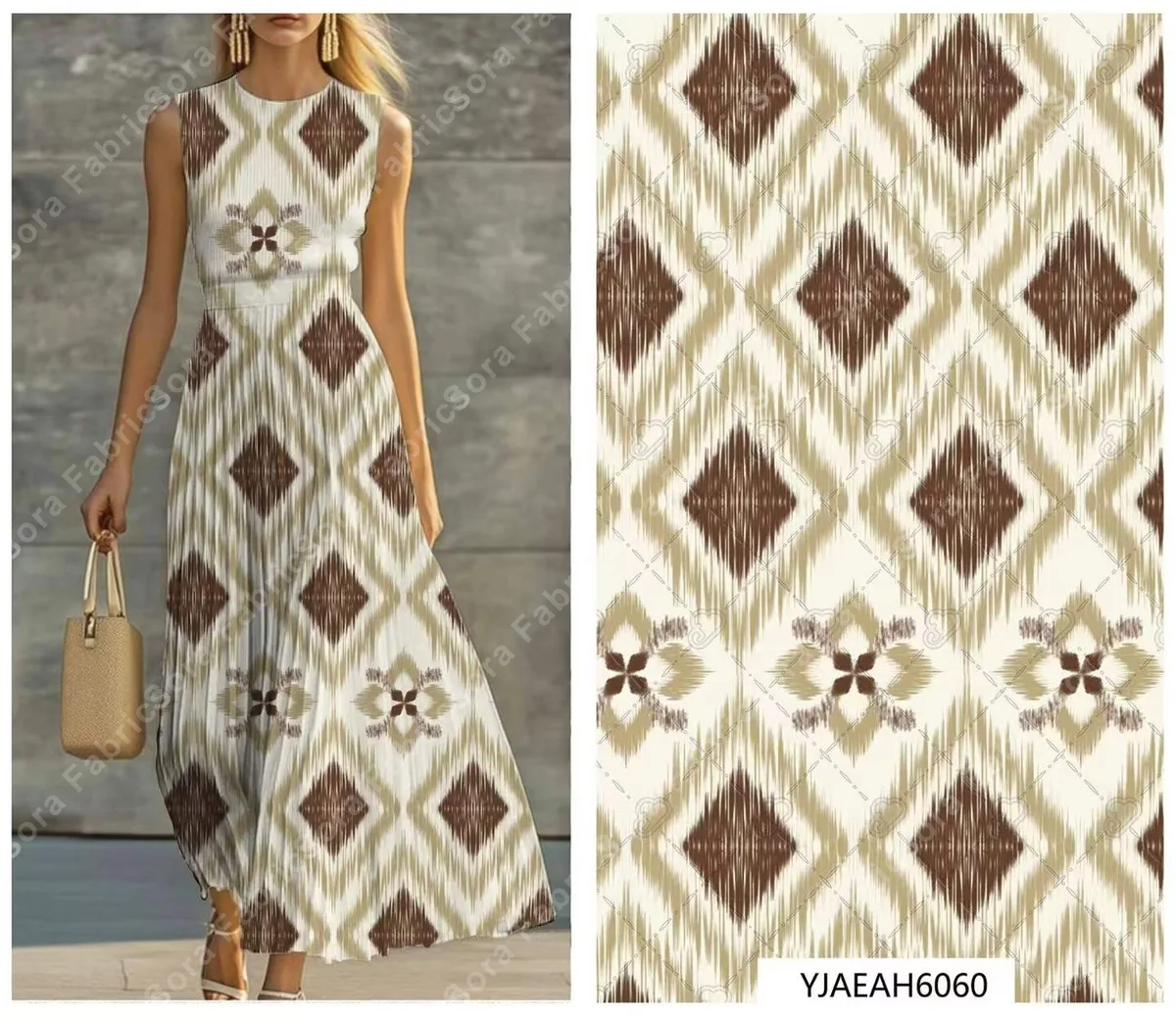
- Cheapest deep-saturated colors — rayon’s dye uptake is unmatched at the price point. The vivid prints in our rayon-ikat-pattern and rayon-african-ethnic bases are only economically possible on rayon.
- Best drape per dollar — at 90-110 GSM rayon flows like a much more expensive fabric.
- Familiar to buyers and factories — every garment factory in the world handles rayon. No special training, no special needles.
The trade-off: wet weakness means rayon dresses can stretch out of shape if washed aggressively. Most rayon care labels read “gentle wash cold” for this reason.
When modal is the right answer
Modal sits in the under-represented middle of the cellulose family. It’s chosen specifically when:
- You want rayon’s hand but with t-shirt-grade strength — modal jersey is the gold standard for premium underwear, sleepwear, and slip dresses.
- The garment is body-hugging — modal’s higher wet strength means it doesn’t sag when worn against the skin and washed frequently.
- You’re working with knits, not wovens — modal dominates jersey markets; rayon dominates wovens.
We don’t carry modal at our mill. It’s a specialist knit fiber and most printed-fabric wholesale buyers (our customer base) don’t need it. If your collection is heavy on knit jersey, you want a modal-specialist supplier, not us.
When lyocell is the right answer
Lyocell — most commonly branded as Tencel by Lenzing — earns its premium for slow-fashion brands and buyers whose retail customer specifically values sustainability:
- Sustainability is part of your brand pitch — Lenzing publishes life-cycle assessments, the NMMO closed-loop process recovers ~99% of solvent, and lyocell can be marketed as “made from sustainably-sourced eucalyptus pulp.”
- Premium price point ($60+ retail dress) — the +60-100% fabric cost vs. rayon is absorbed by the retail margin.
- Drape + slight memory — lyocell holds its shape better than rayon between washes, important for tailored silhouettes.
Our lyocell-bohemian-print base is 100% lyocell at 105 GSM, reactive-dyed. We sell it specifically to brands marketing “sustainable bohemian” at $50+ retail price points.
The tencel-linen blend (our mill’s signature)
A common confusion: tencel-linen is a blend of tencel (lyocell branded by Lenzing) and linen (flax fiber). It’s not a fourth pure fiber — it’s a 50/50 or 70/30 blend that combines lyocell’s softness with linen’s natural slubby texture.
Our tencel-linen-print base runs 55% lyocell + 45% linen at 140 GSM. It’s heavier than pure lyocell (because linen is heavier) and reads as “linen with a soft hand” to the end-customer. This is the fastest-growing blend in our mill, driven entirely by buyers who want a linen look without linen’s roughness.
The honest sourcing tree
Pick rayon if: printed dresses, blouses, kaftans, ethnic wear — and the retail price is mass-to-mid market ($25-60). 80% of our wholesale volume.
Pick modal if: knit jersey end-product (underwear, sleepwear, slip dresses). Find a modal-specialist mill, not a general fabric-print mill.
Pick lyocell if: slow-fashion brand, premium retail ($50+), sustainability claim is part of marketing. Be prepared for 2-3× rayon cost.
Pick tencel-linen if: you want the linen look without the roughness; mid-to-premium retail; spring/summer collections.
Need physical swatches to compare? We send a 4-fiber comparison set (rayon-print, modal substitute, lyocell-blend, tencel-linen) at no charge for first-time wholesale buyers. Request the set and we’ll ship within 2 business days from Guangzhou.