Digital vs Rotary Screen Printing — for Low MOQ Orders
Digital and rotary screen printing have very different MOQ economics. A wholesale mill breaks down which method to ask for at 50, 150, or 1,000+ meters.
You sent your artwork to two Chinese fabric mills for quotes. Mill A quotes $1.20/m at 150 m MOQ with a 25-day lead time. Mill B quotes $2.40/m at 50 m MOQ with a 12-day lead time. Same artwork, same fabric base, same 150 cm width. Twice the price. Which one is ripping you off?
Neither is. The price gap is the printing method: Mill A is quoting rotary screen, Mill B is quoting digital. Both are legitimate techniques, both produce sellable fabric, but the MOQ economics, color limits, and lead time are fundamentally different — and most first-time wholesale buyers don’t know which one their tech pack actually needs.
We run a printing mill near Guangzhou that runs all three common methods — rotary screen, digital, and water-based pigment — and we route every new order to the method that matches its volume + design profile. The choice is rarely “digital good, rotary bad” or vice versa. It’s a decision tree, and this article is the same one we walk every new buyer through.
The two methods, side by side
| Dimension | Rotary Screen Printing | Digital Printing |
|---|---|---|
| Setup cost | $200-400 per color screen engraving | $0 (artwork loads as a file) |
| Color limits | Typically 6-12 spot colors per design | Unlimited (full CMYK + spot) |
| Cost-effective MOQ | 300 m+ (setup amortizes) | 50-200 m (no setup to amortize) |
| Per-meter price at MOQ | $0.88-1.30 (cheaper at volume) | $2.00-3.50 (premium per meter) |
| Lead time (ready stock) | 5-7 days | 5-7 days |
| Lead time (custom artwork) | 25-40 days (screen engraving + sampling) | 10-15 days (file-to-fabric direct) |
| Color accuracy across rolls | High consistency once dialed in | Very high (file-driven) |
| Best fabric base | Rayon, cotton poplin, tencel-linen | Lyocell, light rayon, silk-blend |
| Best design profile | Repeating tile patterns, ethnic motifs | Photo-realistic prints, watercolor, gradients |
The cost curve is the punchline: at 150 m and above, rotary screen is cheaper. At 50-100 m, digital wins because there is no $200-400/color screen setup to amortize across the meterage. The crossover point depends on the number of colors in your design — a 3-color pattern crosses over at ~120 m; a 10-color pattern crosses over at ~400 m.
When digital is the right answer
Digital printing earns its premium per meter when at least one of the following is true for your order:
- MOQ ≤ 200 m per print — small capsule, sample run, or test batch. Setup cost on rotary screen would be 30-50% of total fabric cost.
- More than 12 colors in the design — photographs, watercolor washes, complex gradients. Rotary screen physically caps at ~16 colors and most mills won’t go past 12.
- You need fast turnaround — file-to-finished-fabric in 10-15 days vs. 25-40 days for rotary engraving.
- The design is unique to this order — one-off collection drops, custom corporate prints, scarves with photo reproduction, anniversary capsules.
- You need a sample first — digital can run a 5-meter test cut at near-zero marginal cost. Rotary cannot, because the screens have to be made before any meterage runs.
A typical fit: an indie brand running a 60-piece signature scarf collection with watercolor florals at 80 m total. Rotary would cost $200-400/color × 8 colors = $2,400 setup before the first meter, plus $1.00/m × 80 = $80, for $2,480 total. Digital prints the same job at $2.80/m × 80 = $224. Eleven times cheaper.
When rotary screen is the right answer
Rotary screen earns its low per-meter price when all of the following are true:
- MOQ ≥ 300 m per print — production-scale capsule, mainstream collection, restocks of a proven bestseller.
- Color count ≤ 12 — most prints qualify; rotary excels at clean, bold, repeating motifs.
- You’ll reorder the same artwork — the screen engraving is a one-time cost that pays back across re-orders. A bestseller you order 3x in a year amortizes its $2,400 setup across 900+ meters.
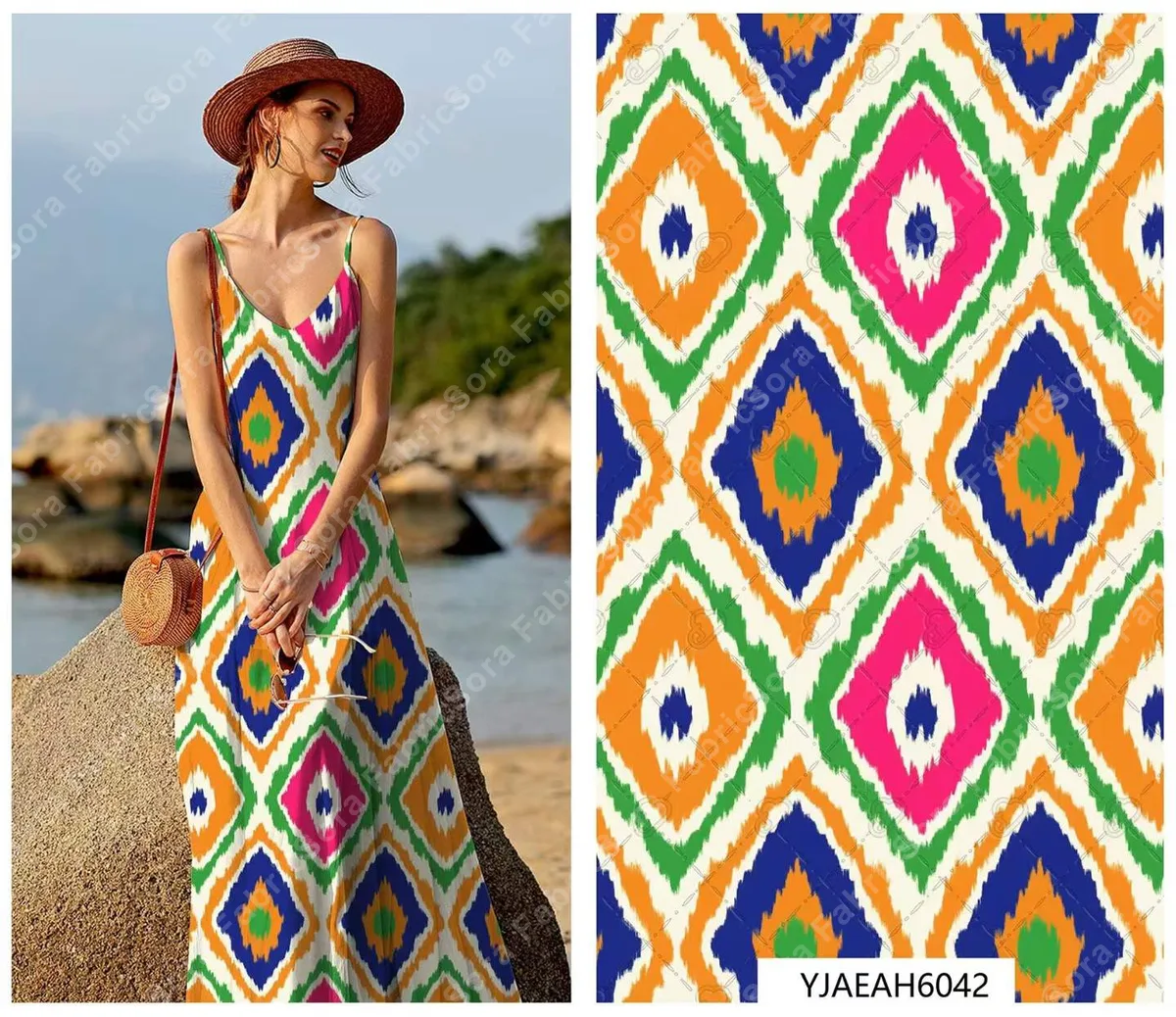
- The pattern is tile-based — repeating florals, paisley, ikat, geometric grids, ethnic motifs. Rotary’s strength is its mechanical repeatability.
- You’re cost-sensitive on landed price — every $0.20/m difference at 1,000 m = $200 saved. At sea freight scale this is meaningful.
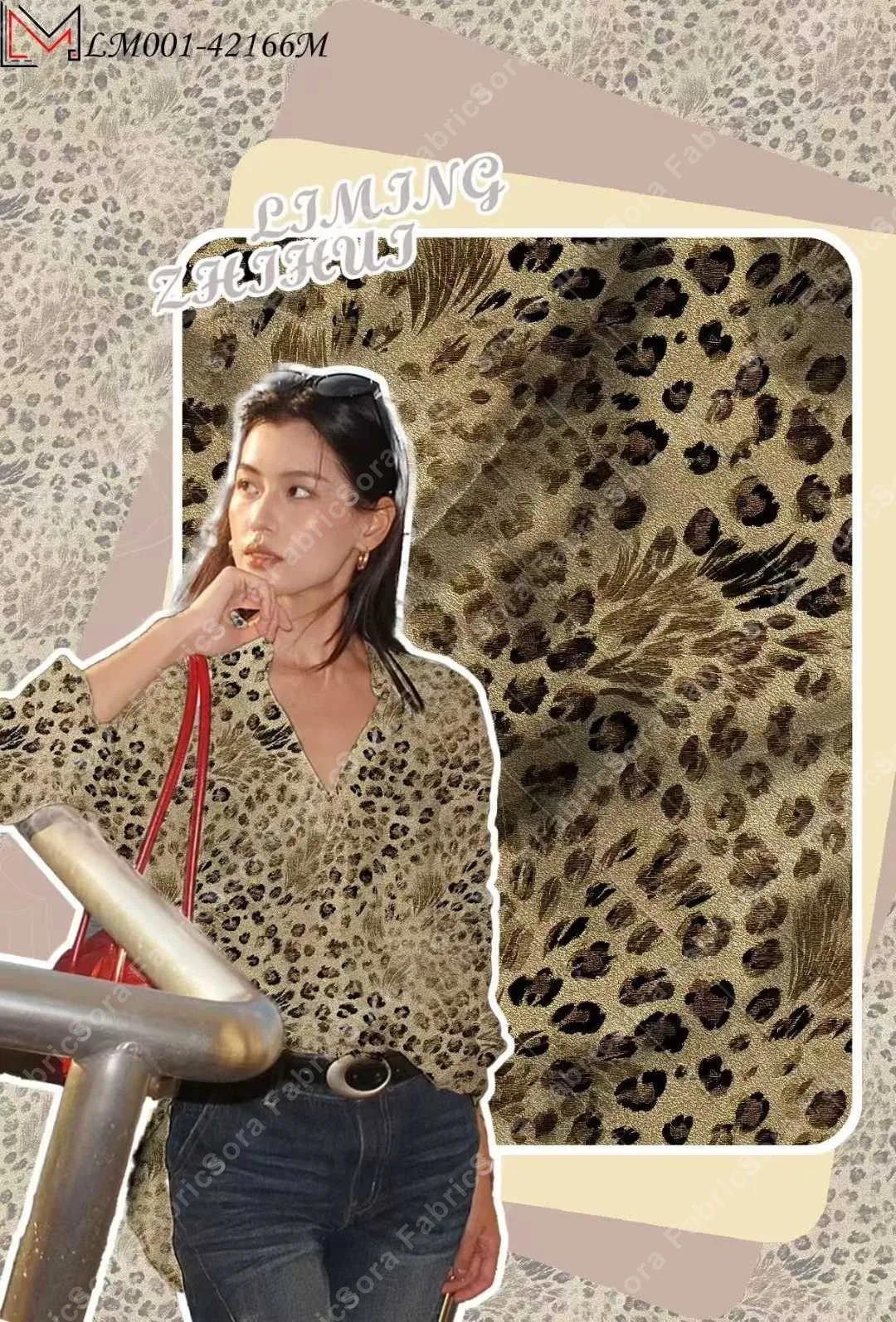
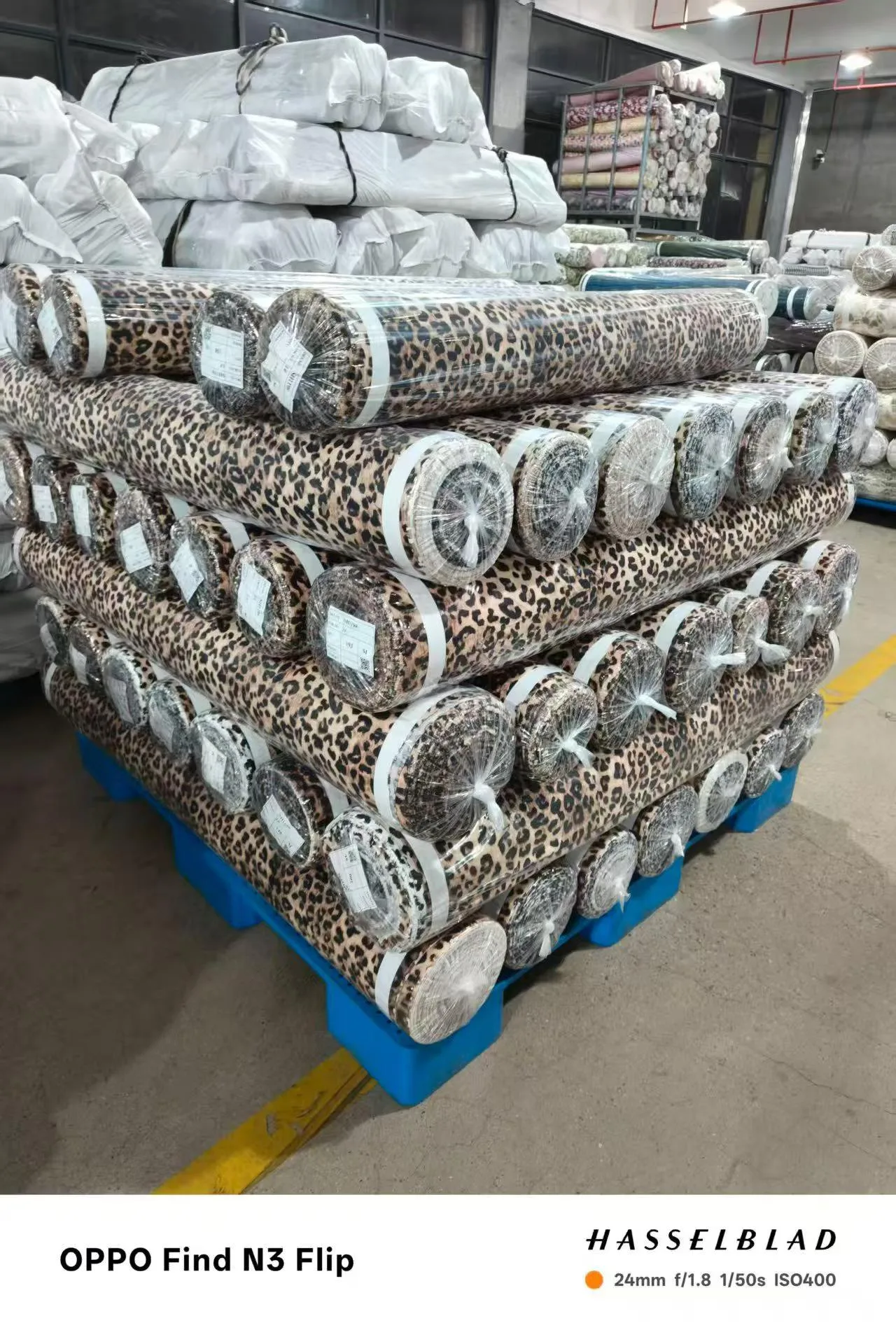
A typical fit: a Brooklyn dress brand reordering its signature 6-color leopard print rayon at 1,500 m for a seasonal restock. Rotary at $0.92/m × 1,500 = $1,380. Digital at $2.40/m × 1,500 = $3,600. Almost three times more. The screen engraving was paid for last season; this reorder is pure margin advantage.
The hybrid case (and how good mills handle it)
A lot of real orders sit between the two extremes. Two scenarios we see weekly:
Scenario A — Indie brand testing a print: 100 m digital for the test capsule. If the print sells through, reorder 500 m on rotary at a 60% lower per-meter cost. This is the smartest path for a first-time print and we route most new artwork through it.
Scenario B — Capsule with one bestseller + 4 variants: 1,500 m of the bestseller on rotary screen ($0.92/m) + 4 variants at 150 m each on digital ($2.80/m). Total: $1,380 + $1,680 = $3,060 for a 2,100 m capsule. The bestseller carries the rotary cost-efficiency; the variants get the file-driven turnaround speed.
A mill that won’t route your order between methods is a yellow flag. Either they only run one method (small operation), or the salesperson is steering you to whichever method gives them the higher commission. Ask: “What method do you recommend for my order, and why?” The right answer is a decision-tree response, not “we always use [method].”
What about water-based pigment printing?
We run a third method — water-based pigment printing — that fills a niche the table above leaves out: eco-conscious labels, kid-safe certifications, and the “natural fiber + natural feel” market. Pigment printing uses no dye-house wastewater, has lower color saturation (which some brands want), and qualifies for OEKO-TEX Class I certification more readily.
| Dimension | Water-based Pigment |
|---|---|
| MOQ | 150-300 m |
| Per-meter cost | $1.10-1.50 |
| Color depth | Soft, matte (lower saturation by design) |
| Best for | Children’s wear, kid-safe certifications, eco brands |
| Hand after print | Softer than rotary (no acrylic binder buildup) |
It’s not a replacement for either digital or rotary — it’s a different sound, and the niche audience that wants it pays the premium happily. For most production runs we still recommend rotary or digital based on the table above.
A concrete scenario: 250-meter “test then scale” path
A US-based indie brand wants to test 3 floral prints across a 250-meter pilot, then reorder the bestseller at production scale. Working with us, the cost breakdown looks like this:
Pilot (digital):
- 3 prints × 80 m of rayon at $2.40/m digital = $576 fabric
- 12 days lead time (10 days printing + 2 days finishing)
- Air freight ~25 kg = $90
- Landed cost ~$666 to validate which print sells
Scale-up (rotary, 8 weeks later):
- Bestseller reorder: 1,200 m of the winning print at $0.92/m rotary = $1,104
- One-time screen engraving (5 colors × $250) = $1,250
- 28 days production + sea freight = $230
- Total ~$2,584 for 1,200 m, landed cost $2.15/m
Without the digital pilot, the brand would have either guessed which print sells (high dead-stock risk) or paid the rotary premium per print upfront (3 × $1,250 = $3,750 in setup before the first meter ships). The two-method path turns a $4,400 launch budget into a $666 validation + $2,584 scale-up = $3,250 total, with far lower dead-stock risk because only the proven winner got the scale order.
Quick decision tree
Run your order through these three questions in order:
- Is the total MOQ for this print < 200 m? → Digital (rotary setup doesn’t amortize)
- Are there > 12 colors or photo-realistic gradients? → Digital (rotary physically caps)
- Will you reorder this artwork within 12 months? → Rotary (amortize across reorders)
If you fail all three, the order can go either way and the deciding factor is lead time (digital wins) vs landed cost (rotary wins). Ask the mill to quote both.
For the broader sourcing context see Low MOQ Fabric Sourcing for Indie Fashion Brands and How to Import Printed Fabric from China.
Get a routed quote
Send us your artwork and target MOQ at Sorafabrics on WhatsApp. We’ll quote both methods side by side and recommend the one that fits your design profile and volume — no commission steering, just the routing logic above. Or browse our ready-stock prints if you’d rather start from a finished pattern at 150 m MOQ.