Ikat Fabric Origins: 8 Centuries from Bukhara to Bali to Bahia
Ikat traveled 1,200 years from Silk Road Bukhara through Bali, Guatemala and Paris runways to today's wholesale mills. A Chinese mill traces the journey.
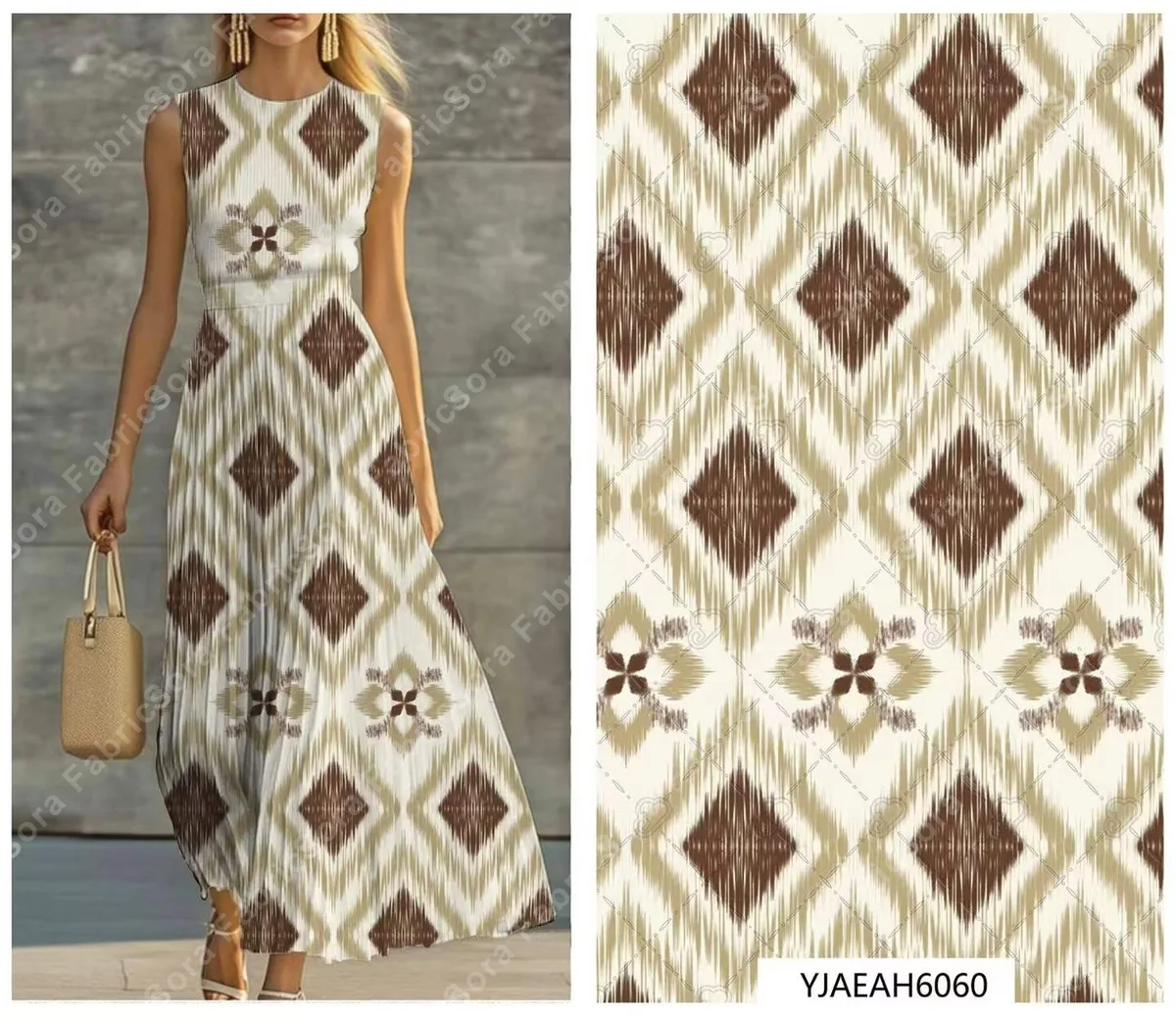
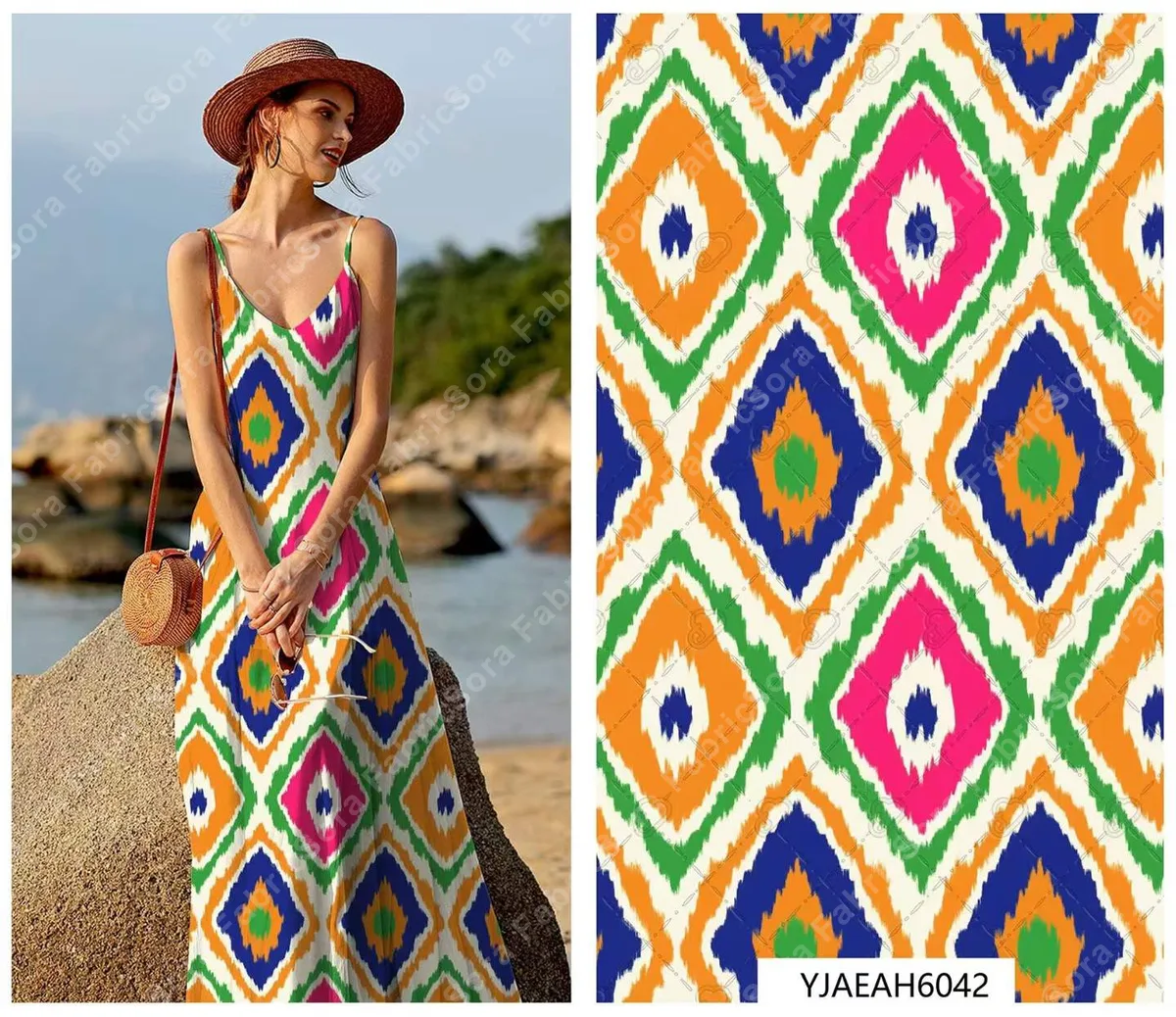
A French boutique buyer this spring asked us for “tissu motif ikat” — printed ikat fabric for a 2026 capsule. A Brazilian wholesaler the same week asked for “estampa ikat” for resort dresses. A US Etsy seller ordered “ikat print” for kids’ wear. Three buyers, three continents, one pattern.
What none of them said out loud is that the motif on their reference photo can be traced back, almost link by link, to a specific moment in 8th-century Central Asia — and that the reason it ships at $1.10/m from a Guangzhou mill today is the same reason it cost more than gold in medieval Bukhara: it captures light in a way printed-flat fabric cannot.
This is the story of how ikat traveled 1,200 years from a single silk-trading city to land, simultaneously, on a Parisian boutique rack, a Bali resort uniform, and a Brazilian praia dress in the same season. We run a Chinese printing mill that ships ikat-motif rayon at wholesale scale; this is the heritage context we wish every first-time ikat buyer had before they spec’d an order.
8th century: Bukhara invents the look
The earliest evidence of resist-dyed warp yarns appears in Bukhara and Samarkand along the Silk Road around the 7th-8th century. These weren’t villages with looms — they were the wealthiest trade cities on Earth, sitting on the chokepoint between Persian, Chinese, and Indian textile markets. The technique that emerged there, called abrbandi (“cloud-tying” in Persian, because the dye edges blurred like clouds), produced the cloth Westerners now call ikat.
Two distinct local traditions developed:
- Atlas — pure silk, dense saturated colors, jewel tones (cochineal red, lapis blue, gold, emerald). Used for women’s robes and royal gifts. So expensive that in some periods atlas robes were given as diplomatic currency between khanates.
- Adras — silk warp, cotton weft, slightly cheaper but with the same vertical-dominant pattern. The everyday version that ordinary Bukhara families could afford for festival clothing.
The pattern vocabulary that emerged in those workshops — vertical bands, lightning-bolt zigzags, pomegranate motifs, the “scorpion tail” hook — is still the visual template for what Western buyers recognize as “ikat” today. Walk into a Marseille concept store in 2026 and the ikat dress on the rack is, motif-wise, a direct descendant of 8th-century Bukhara.
Silk Road south: ikat reaches Indonesia
The Silk Road wasn’t a single road — it was a web of trade routes that ran north overland to China, south by sea to India and Indonesia, and west to Persia and Byzantium. By the 13th century the resist-dye-and-weave technique had reached the Indonesian archipelago by ship, carried with the textile-merchant communities that settled in port cities like Aceh and Makassar.
What happened next is the most important moment in ikat history: Indonesian weavers rotated the technique 90 degrees. Instead of tying off the warp threads (vertical), they tied off the weft (horizontal). Same resist principle, completely different visual result.
This is why Southeast Asian ikat looks fundamentally different from Central Asian ikat:
- Bali endek — horizontal repeating bands of geometric figures, hooks, stylized birds and flora. Used today as the everyday textile of Balinese hotel uniforms, ceremonial dress, and resort wear that Australian and Japanese designers source by the bolt.
- Sumatra / Sumba hinggi — large square panels with abstract animal forms (horses, birds, fish), traditionally given as mortuary gifts. Now collected as art textiles and adapted into resort cushions and runners.
- Bali gringsing — the only double ikat in the world (both warp and weft are resist-dyed before weaving), produced in a single village called Tenganan. Each piece takes five to eight years. There are essentially no wholesale buyers in this category; the entire output is collector-grade.
- Cambodian hol— weft-dominant ikat in silk, traditionally women’s sampot skirts. Largely interrupted by the Khmer Rouge era, now being revived through cooperative weaving programs.
When a Bali resort label asks our mill for “ikat”, they almost always want the endek-derived horizontal-band motif — earth tones, indigo, terracotta — not the saturated Central Asian look. Getting this wrong is the single most common reason an ikat capsule under-performs in tropical-aesthetic retail.
Colonial trade routes: ikat lands in Latin America
The technique reached the Americas through Spanish and Portuguese colonial trade routes starting in the 16th century, but it didn’t arrive as a finished cloth. It arrived as a technique transferred to local weavers — partly through enslaved African artisans who already knew resist-dye methods, partly through indigenous weavers who incorporated it into pre-existing traditions.
The result is a third regional family:
- Guatemalan jaspe — tight, multi-color geometric bands in pink, turquoise, yellow, magenta. Used in huipiles (traditional blouses) and cortes (wrap skirts). Each Maya community has its own pattern dialect that signals village origin.
- Bolivian / Peruvian aguayo — square-tile compositions with high color counts, used for carrying cloths (the manta slung over a woman’s back for transporting children or goods). Pre-Inca patterns reinterpreted through colonial dye chemistry.
- Brazilian regional adaptations — most often called tecido amarrado or marketed simply as estampa ikat. Strong in Northeastern coastal markets where the resort and beach trade pulls from both African and Andean visual traditions.
The Latin American family is what most US Southwestern brands, Mexican wholesale buyers, festival-wear labels, and Brazilian praia lines actually want when they ask for “ikat”. Pastel versions don’t sell here — the market expects maximum saturation.
20th century: Paris discovers ikat
Ikat remained a regional textile until the 1960s-70s, when European fashion designers began collecting Central Asian and Indonesian examples on travels and reinterpreting the motifs on runway. The pivotal moments:
- Yves Saint Laurent’s 1976 “Opéra-Ballets Russes” collection drew heavily on Central Asian motifs, with ikat-patterned coats and dresses that put the look in front of Western luxury buyers.
- Issey Miyake’s 1980s collaborations with Japanese textile artists pulled Indonesian weft-ikat into avant-garde drapery.
- Dries Van Noten and Etro built decades-long ikat references into their brand DNA from the 1990s onward, normalizing the motif as a luxury staple.
By the late 1990s ikat was no longer a regional textile — it was a shared global vocabulary, used by designers from Tokyo to Antwerp to Mexico City. But the cloth was still mostly hand-woven, mostly expensive, and mostly out of reach for indie wholesale buyers.
21st century: the printed wholesale revolution
The shift from hand-woven to printed reproduction happened in three waves:
Wave 1 (early 2000s): Indian and Indonesian mills began screen-printing ikat motifs on cotton voile for the European resort-wear market. Quality was inconsistent but prices dropped 30-50× compared to hand-woven.
Wave 2 (2010s): Chinese rotary-screen mills industrialized ikat printing on rayon, hitting a price point ($0.90-1.40/m) and consistency level that put the look in fast-fashion supply chains. Zara, H&M, and Mango all carried ikat-pattern viscose seasonally.
Wave 3 (2020s): Digital printing closed the last gap — small wholesale buyers can now order 100-150 m of custom ikat artwork with 12-15 day lead times. Combined with rotary for larger reorders, this gave indie designers access to a pattern category previously gated by 1,000 m MOQ.
Today’s ikat supply chain is split across:
| Production type | Where | Price range | Typical buyer |
|---|---|---|---|
| Hand-woven authentic | Uzbekistan, Bali, Guatemala | $40-200/m retail | Collectors, museums, luxury boutiques |
| Printed wholesale (rotary) | China (Guangzhou), India | $0.85-1.30/m FOB | Mass market wholesalers, brand licensees |
| Printed wholesale (digital) | China, Turkey, Italy | $2.00-2.80/m FOB | Indie designers, capsule collections |
| Designer reissues | Italy, France | $30-80/m retail | High-street brands sourcing licensed motifs |
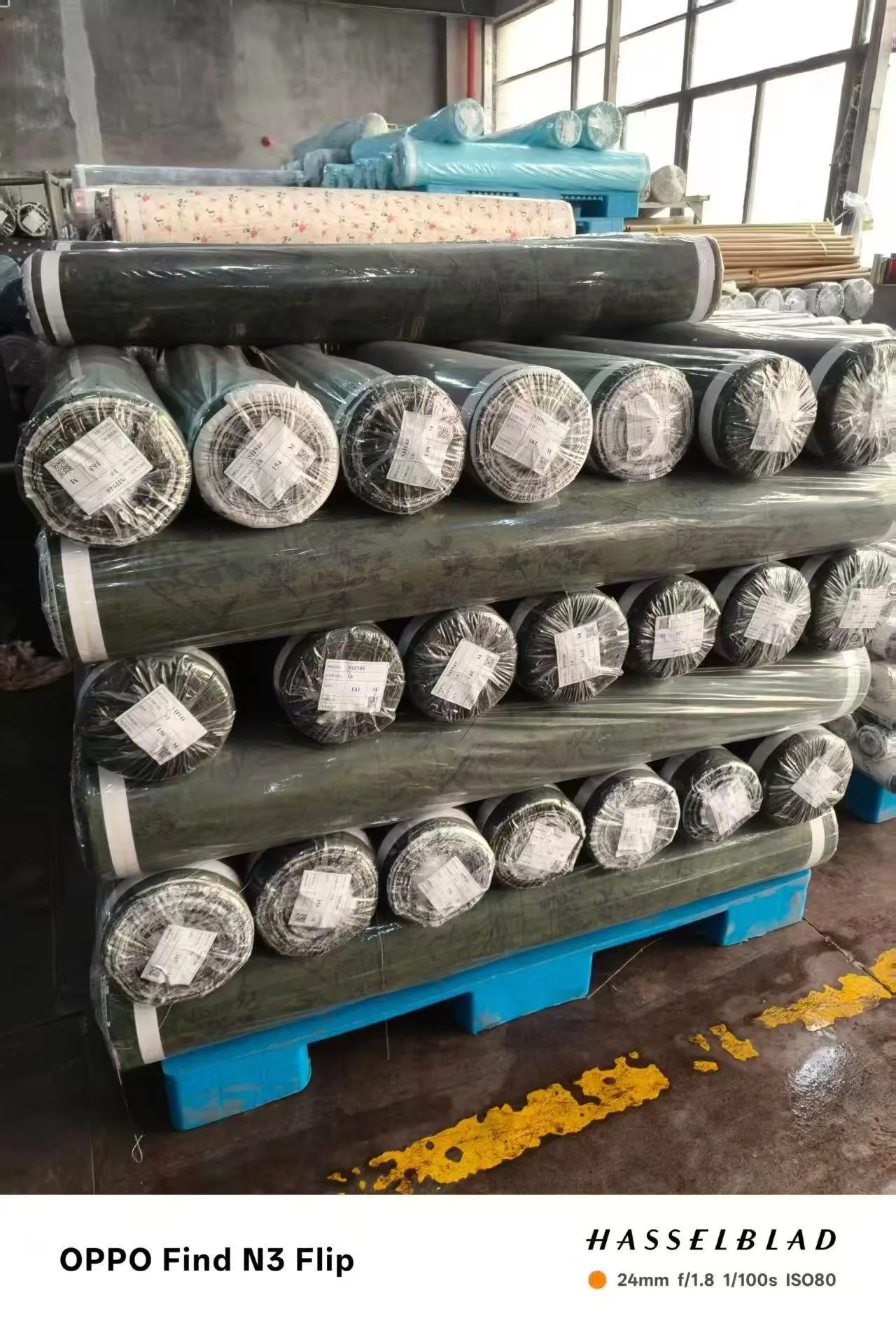
Our mill sits in the second category — Guangzhou rotary and digital, 150 m MOQ on ready stock, 300 m on custom rotary. The pricing math and method-by-method breakdown is in our ikat motif wholesale buyer’s guide.
Why ikat is having a sustained 2026 moment
Three forces converged this cycle, and all three are still gaining momentum:
- The “global eclectic” interior trend. Pinterest and Instagram aesthetics that mix patterns from multiple traditions — Central Asian rugs with Indonesian cushions with Latin American throws — pulled ikat into home textiles, and home textile demand spilled into apparel. Buyers who started with cushion covers are now ordering ikat dresses too.
- Heritage marketing in DTC fashion. Indie brands are increasingly building stories around “where the pattern comes from” as part of their marketing copy. Ikat is uniquely well-suited to this because every motif family has a real, documentable origin — unlike generic floral prints that have no traceable lineage.
- The post-pandemic shift toward “considered” wardrobes. Buyers want fewer pieces with more visual depth. Ikat hits this brief perfectly — it reads as artisanal even when printed industrially, and it ages well in a closet because the look isn’t tied to a specific micro-trend cycle.
For wholesale buyers, the practical takeaway is that ikat is not a flash trend — it’s an ongoing market with stable demand and clear regional submarkets. Picking the right family (Central Asian for French boutiques, Indonesian for Bali resort, Latin American for US Southwestern brands) is the single biggest predictor of whether your capsule sells.
Sourcing ikat for a 2026 collection
If you’re building a capsule, the decision tree we’d walk you through on the first call:
- Which regional family fits your customer? Send us a reference image, not just the word “ikat” — see our motif family guide for the four families and which sells where.
- What’s your MOQ comfort? Ready stock (150 m) lets you test before committing. Custom artwork makes sense from order #2 onward.
- Which base fabric? Rayon for drapy dresses, rayon-linen blend for resort wear, cotton poplin for kids’ and shirting. The base-fabric tradeoffs are covered in the buyer’s guide.
- Rotary or digital? Depends on order size and reorder plans. Crossover sits around 180-220 m for ikat at typical 6-10 color counts.
The motif is half the order; the base fabric and print method determine whether your finished garment lives up to the heritage the pattern carries.
Send us your ikat reference
We carry the four major motif families as ready-stock rayon at 150 m MOQ. Send your reference image to Sorafabrics on WhatsApp — we’ll identify which regional family it belongs to, suggest the closest match from our stock, and quote both ready-stock and custom-print options side by side. Or browse our ikat pattern collection directly.
For the deeper sourcing context, see Ikat Motif Wholesale Fabric: Buyer’s Guide for the MOQ ladder and printing-method breakdown, and How to Import Printed Fabric from China for the freight and customs side once you’ve decided on a motif.