Ikat Motif Wholesale Fabric: A Buyer's Guide to Patterns & MOQ
Ikat motifs trace to Central Asia, Indonesia and Latin America. A Chinese wholesale mill explains pattern families, print routes, and ikat-rayon MOQ economics.
A boutique buyer in Marseille asks for “ikat fabric” and means a Central Asian adras with sharp warp-resist lines. A Bali resort label asks for “ikat” and means an Indonesian endek with horizontal weft transitions. A São Paulo brand asks for “estampa ikat” and means a printed imitation of the look — they don’t want hand-woven, they want the motif at wholesale price.
Three buyers, one word, three different products. If you’re sourcing ikat for a 2026 capsule and the mill quotes you back “ikat rayon at $1.10/m, MOQ 150”, you need to know which of the three they’re talking about — and whether the motif family they print matches what your customer will actually buy.
We run a printing mill near Guangzhou that produces ikat-motif rayon at wholesale scale. This guide is what we walk every new ikat buyer through on the first call: where the patterns come from, what variants sell in which markets, and how to spec an order that doesn’t waste setup cost on the wrong technique.
What “ikat” means at wholesale
True ikat is a resist-dye weaving technique — yarns are bundled and tied off, dyed, then woven so the design emerges as the cloth is built. The signature look is the soft, slightly blurred edge where the dye bled into the resist. Hand-woven ikat takes weeks per piece and runs $40-200/m at retail. It is not a wholesale category.
What ships as “ikat fabric” in wholesale is almost always a printed reproduction of the motif on a stable woven base — typically rayon (viscose), occasionally cotton poplin or rayon-linen blend. The print captures the soft-edge look that buyers recognize as “ikat”, at a per-meter cost 30-50× lower than hand-woven. This guide covers the printed version unless explicitly noted otherwise.
A quick disambiguation, because this trips up first-time orders:
| What buyer asks for | What buyer usually means | What to quote |
|---|---|---|
| ”Ikat fabric” | Printed ikat motif on rayon | Printed wholesale ($0.90-1.40/m) |
| “Real ikat” / “Hand-woven ikat” | Resist-dyed woven cloth | Specialty workshop, not wholesale |
| ”Ikat print” | Same as “ikat fabric” above | Printed wholesale |
| ”Motif ikat” (French market) | Printed ikat motif | Printed wholesale |
| ”Estampa ikat” (Brazilian / Portuguese) | Printed ikat motif | Printed wholesale |
Always confirm with one question: “Are you sourcing for printed reproduction or hand-woven authentic?” That single question saves both sides a week of back-and-forth quotes.
The four ikat motif families (and which sells where)
Ikat is not a single look. The pattern vocabulary splits into four geographic families, and each sells to a different end market. Choosing the wrong family for the wrong customer is the most common reason an ikat capsule under-performs.
1. Central Asian (Uzbek / adras / atlas)
Bold vertical bands, lightning-bolt zigzags, and pomegranate-derived shapes in saturated jewel tones — emerald, cochineal red, lapis blue, gold. The motif is vertical-dominant because the warp threads carry the design.
Sells to: French and Italian boutique buyers (Marseille, Milan, Paris), Middle East women’s wear, US bohemian-resort labels. Strong overlap with the “global eclectic” interior trend.
Tonal range: Saturated, contrast-heavy. Avoid pastels.
2. Southeast Asian (Indonesian endek / gringsing, Cambodian hol)
Horizontal repeating bands of geometric figures — diamonds, hooks, stylized flora and fauna. The motif is horizontal-dominant because Southeast Asian weavers use weft-resist more than warp-resist.
Sells to: Australian and Bali resort labels, Indonesian domestic brands, Japanese minimalist wholesale, tropical-aesthetic Etsy sellers. Lower contrast palettes (terracotta, indigo, off-white) outsell saturated versions.
Tonal range: Earth tones, indigo, ochre. Saturated jewel tones look wrong in this family.
3. Latin American (Guatemalan / Bolivian aguayo)
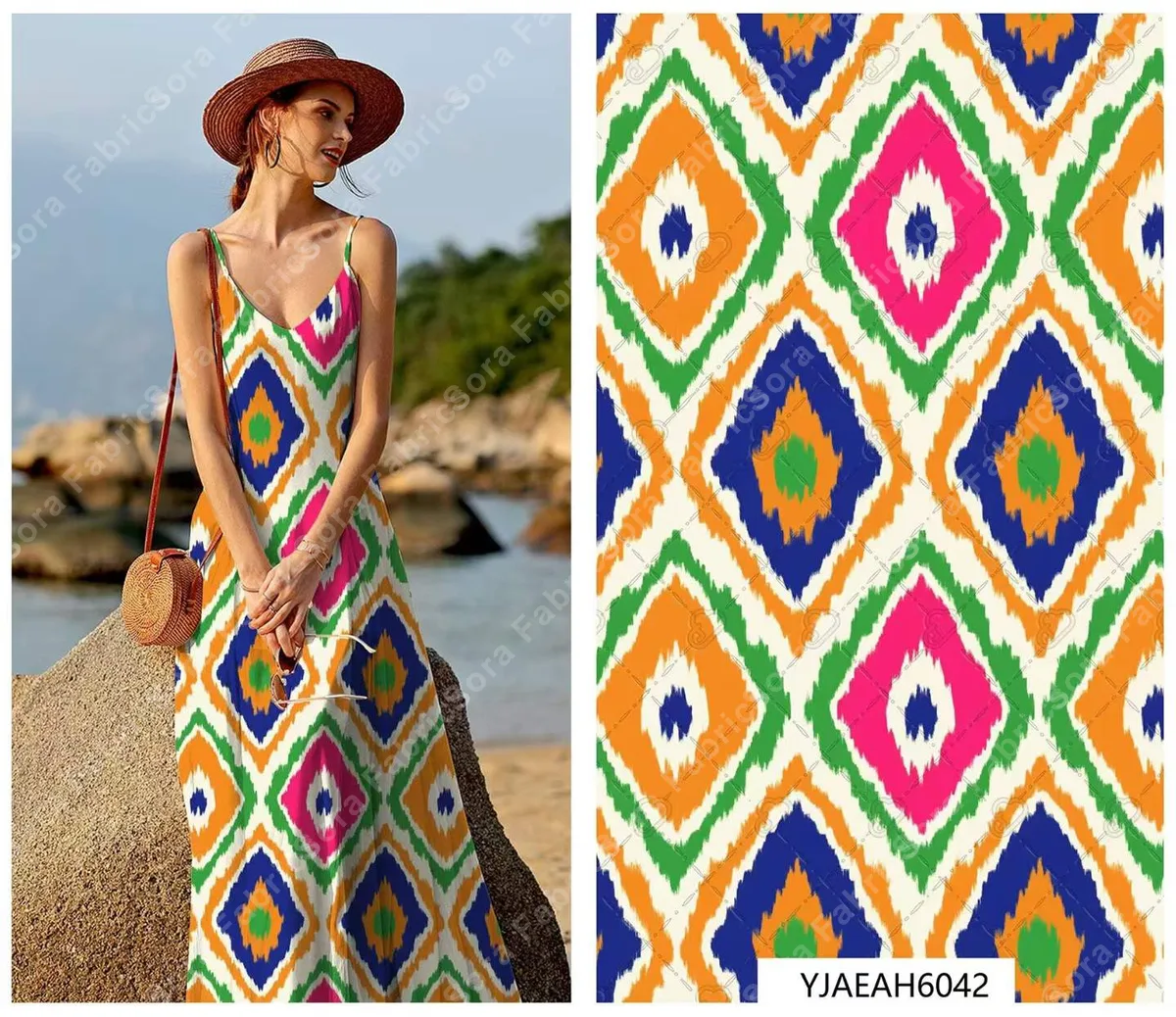
Tight, multi-color geometric bands separated by narrow stripes — pink, turquoise, yellow, magenta in high-contrast stacks. Often square-tile compositions rather than the flowing forms of the other families.
Sells to: US Southwestern aesthetic brands, Mexican wholesale, festival/burner wear, kids’ wear (high color count reads as playful). Strong in Brazilian “estampa étnica” segment.
Tonal range: Maximum saturation. Pastel versions don’t sell here.
4. Hybrid / contemporary
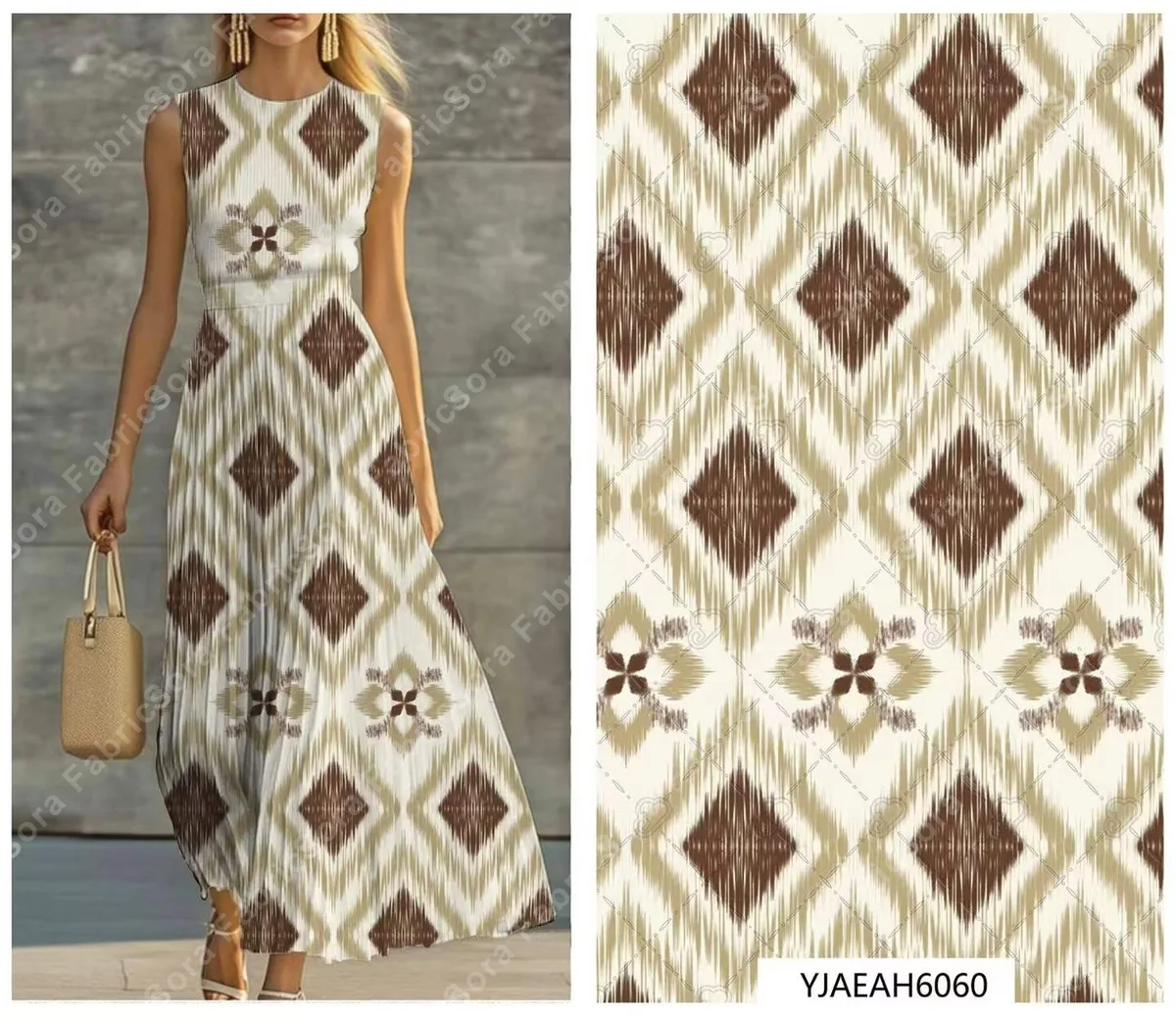
Designers riff on ikat without committing to a single tradition — softer edges, lower color counts, larger pattern repeats, sometimes combined with tropical or floral elements. The “ikat-inspired” look that dominates fast fashion right now.
Sells to: Mainstream fashion wholesalers, brand-name licensee mills, mass-market dress brands. Lower margin, higher volume.
Tonal range: Wide. The brief usually arrives as a tear sheet from Pinterest rather than a regional reference.
We stock all four families as ready-stock rayon at 150 m MOQ — see our ikat pattern collection for the current motifs. If you need a specific regional variant we don’t carry, custom-print MOQ starts at 100 m on digital or 300 m on rotary.
Printing route: rotary vs digital for ikat
Ikat is the exact design profile where the rotary-vs-digital decision matters most. Because traditional ikat uses 6-10 spot colors with sharp boundaries, it sits right on the crossover point of the two methods.
Rotary screen wins when:
- You’re ordering ≥ 300 m of a single ikat print
- The motif has ≤ 10 colors (most traditional ikat qualifies)
- You’ll reorder the same artwork — ikat bestsellers tend to restock 2-3x per year because the look is timeless
- Cost per meter matters more than turnaround speed
Digital wins when:
- You’re testing 3-5 ikat variants at 50-100 m each
- The motif has > 12 colors or photo-realistic dye bleed (contemporary hybrid family)
- You need samples in 10-15 days for a trade show
- The capsule is a one-off (no reorder planned)
The full method-by-method breakdown — including the cost crossover math — is in Digital vs Rotary Screen Printing for Low MOQ Orders. For ikat specifically: the crossover sits around 180-220 m at 8 colors. Below 200 m, digital is cheaper. Above 250 m, rotary wins by a wide margin.
Base fabric: which weight and fiber for ikat
The motif is half the order. The base fabric determines whether your finished garment drapes like a $200 dress or a $30 dress. For ikat specifically, three bases cover 90% of wholesale demand:
| Base | Weight | Best for | Per-meter cost (printed ikat) |
|---|---|---|---|
| Rayon (viscose) 100% | 110-130 GSM | Dresses, scarves, wide-leg trousers, kimono jackets | $0.90-1.40 |
| Rayon-linen blend (85/15) | 130-160 GSM | Resort wear, beach cover-ups, structured tops | $1.30-1.80 |
| Cotton poplin | 100-120 GSM | Shirting, children’s wear, kid-safe markets | $1.40-2.00 |
Rayon is the workhorse — about 75% of wholesale ikat ships on rayon because it takes the soft-edge ikat aesthetic better than crisp cotton (the slight halation of the print actually mimics the dye-bleed of woven ikat). For GSM selection on the rayon base, see What Does Fabric GSM Mean — 110 GSM drapes best for dresses, 130 GSM for structured pieces.
If your buyer is asking for “ikat tencel” or “ikat lyocell”, that’s a different conversation — those bases are usually digital-printed because lyocell handles digital ink better than rotary. See Lyocell vs Modal vs Rayon for the fiber tradeoffs.
MOQ ladder and pricing reality
What new wholesale buyers actually pay for ikat-print rayon, FOB Guangzhou:
| Order size | Method | Per-meter price | Lead time |
|---|---|---|---|
| 150-200 m (ready stock, our motif) | Pre-printed inventory | $1.00-1.20 | 5-7 days |
| 100-150 m (your motif, digital) | Digital print on demand | $2.20-2.80 | 12-15 days |
| 300-500 m (your motif, rotary) | Rotary screen, 6-8 colors | $1.05-1.30 | 28-35 days |
| 1,000+ m (your motif, rotary reorder) | Rotary, screens amortized | $0.85-1.05 | 22-28 days |
| Sample cut (any motif) | 2-3 m for inspection | $15-30 flat | 3-5 days |
The ready-stock tier is where most first orders land — pick a motif from an existing wholesale catalog, take 150 m at $1.00-1.20, get a feel for the fabric and the supplier before committing to custom print MOQ. Custom artwork makes sense from order #2 onward, once you know which family sells to your customer.
For a deeper look at the supplier-screening and sample-vetting process, see Low MOQ Fabric Sourcing for Indie Fashion Brands.
Pre-order checklist for ikat-print rayon
Before you confirm the PO, walk through these six items with the mill. Most ikat returns trace back to one of them not being addressed upfront:
- Motif family confirmed in writing. Send a reference image, not just “ikat”. A Central Asian adras and an Indonesian endek are both “ikat” but will land very differently with your customer.
- Color palette spec’d by Pantone or sample swatch. “Red and blue” is not a spec. Ikat looks washed out if the contrast palette is wrong, regardless of how good the printing is.
- GSM matched to garment type. 110 GSM for flowy dresses, 130 GSM for tailored pieces, 150+ GSM for resort/structured. A 130 GSM ikat dress will hang heavily; a 110 GSM ikat jacket will look limp.
- Print method noted on PO — “rotary screen” or “digital” — so the mill cannot quietly substitute the cheaper method on a small order.
- Sample cut approved before bulk runs. 2-3 meters is enough to check color accuracy and hand feel. Skip this step and you risk 150-500 m of fabric you can’t sell.
- Wash test before cut and sew. Ikat colors should hold through 10+ machine washes. Reactive-dyed prints handle this better than pigment prints — see Reactive vs Pigment Printing for the chemistry.
Where ikat fits in a 2026 collection
Ikat is having a sustained moment in three end-markets right now:
- Bohemian / resort wear — the Central Asian and Hybrid families pair naturally with maxi dresses, kimono jackets, and beach cover-ups. Spring/summer drop dominant.
- Children’s wear — the Latin American family reads as playful and high-color, and ikat hides small stains better than solid colors (a quiet selling point for parent buyers).
- Home textiles spillover — buyers sourcing for apparel often add cushion covers and napkin runs in the same motif. We’ve shipped 300 m apparel + 80 m home goods on the same PO multiple times — worth asking your supplier if they can run both.
The pattern itself has been around for centuries; what changes is which family dominates and which silhouette it gets cut into. For 2026, the Hybrid family (lower contrast, larger repeat) is leading retail, and the Central Asian family is the strongest indie-boutique seller.
Get an ikat quote routed
Send us your reference image and target MOQ at Sorafabrics on WhatsApp. We’ll identify the motif family, recommend rotary vs digital for your order size, and quote both the ready-stock and custom-print options side by side. Or browse our ikat pattern ready stock if you’d rather start from a finished motif at 150 m MOQ — fastest path from PO to shipped roll.
For sourcing context beyond ikat specifically, see How to Import Printed Fabric from China for the freight and customs side, and Low MOQ Fabric Sourcing for Indie Fashion Brands for first-time supplier selection.