What is Tencel-Linen Blend Fabric? A Mill's Guide
Tencel-linen blend printed fabric explained — composition, weight, how it differs from real tencel and real linen, and what indie brands actually use it for.
A US-based ready-to-wear designer messages us: “I need that crisp linen look but I can’t afford real linen for a 200-piece capsule. Do you have anything that drapes like linen but prints like rayon?” The answer is tencel-linen blend — and the longer answer is that the name itself is part marketing, part real fiber science, and the part most buyers don’t know is the part that decides whether the fabric is right for their product.
We run a mill that ships printed tencel-linen fabric to 30+ countries every week, and we wrote this guide because the question “what is tencel-linen?” comes up on roughly every third new-buyer WhatsApp. The short answer: it is a printed fabric base engineered to look and feel like a tencel-linen blend, but the actual composition is usually different from what the name suggests. The rest of this article is from the mill floor, not a fiber-school textbook.
The composition, said plainly
Our tencel-linen blend is composed of 85% Rayon (Viscose) + 15% Nylon, woven to deliver a slubby, linen-like surface texture with the drape of rayon. The fabric weighs 120-125 GSM, comes in 150 cm width, and prints beautifully with both rotary screen and digital methods.
This is what the trade calls a faux tencel-linen — the aesthetic and hand feel of a tencel + linen blend, built from a different fiber stack. The reasons we (and most printed-fabric mills) use this construction instead of real tencel + real linen:
| Constructing real tencel + linen | Why mills use faux instead |
|---|---|
| Real linen is ~$5-8/m wholesale (flax fiber cost) | Faux delivers similar hand at $1.15-1.30/m |
| Real linen wrinkles aggressively; print blurs on wrinkles | 85/15 Rayon-Nylon holds prints crisp; nylon adds wrinkle recovery |
| Tencel + Linen blends have minimum dye runs of 1,000+ m | 85/15 prints down to 150 m MOQ with rotary screen |
| Real tencel-linen colors fade in heavy print coverage | 85% Rayon takes reactive dye + pigment ink consistently across roll lots |
| Hand feels luxurious but is heavy (~180-220 GSM) | 120-125 GSM is the dress-and-blouse sweet spot for warm climates |
A real “100% Tencel + 100% Linen” blend exists, but it is sold mostly as solid-dye yardage through performance-textile importers, not as a printed-fabric base. If your tech pack says “100% tencel-linen” and you are sourcing prints, you are almost certainly looking at the faux composition.
What “tencel-linen-look” actually means on the fabric
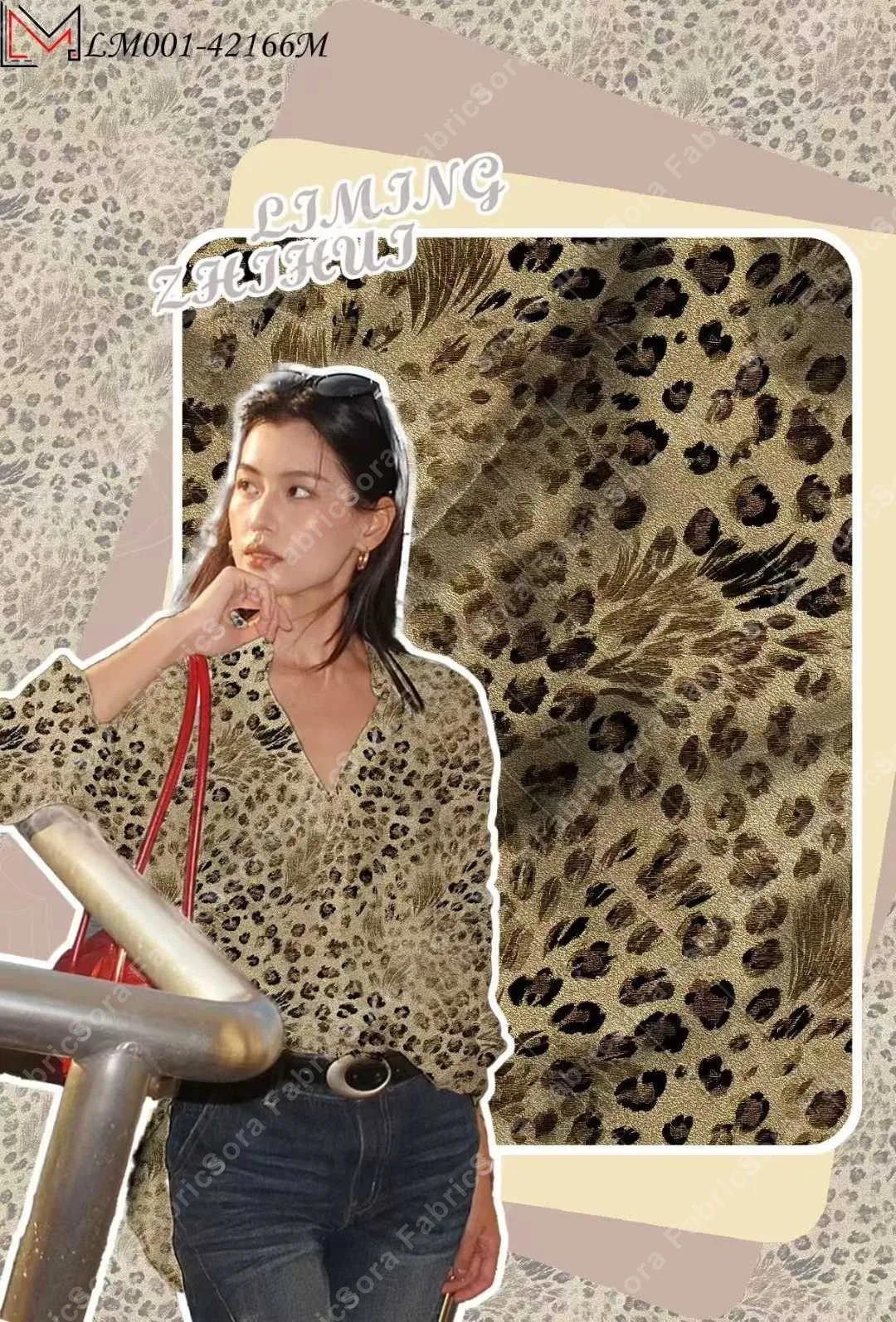
The visual identifier is the slub. Slubs are the small thickenings in a yarn — small knots of fiber that interrupt an otherwise smooth surface. Real linen has slubs because the flax fiber is naturally uneven; they’re a defect that became a feature. In our faux tencel-linen blend, slubs are engineered into the weave — the rayon yarn is intentionally spun to mimic flax’s irregularity, and the 15% nylon stabilizes the structure so the slubby surface doesn’t unravel during printing or wash.
A buyer can identify our fabric in three seconds with a swatch:
- Surface: visibly textured, not smooth like 100% rayon. Hold it to a window — you’ll see uneven yarn density.
- Drape: falls heavier than rayon (because 120-125 GSM > rayon’s 90-100 GSM) but lighter than real linen (180+ GSM).
- Wrinkle test: scrunch it in your fist for 5 seconds. Real linen stays wrinkled. Our blend springs back about 70% — the nylon does that work.
If the swatch you got from a supplier looks smoother than this, you have 100% Rayon labeled as “tencel-linen” — a misrepresentation we see roughly once a month on competitor samples landing on our QC bench.
How it prints (and what to watch for)
Tencel-linen blend prints differently from straight rayon in three ways that matter for your tech pack:
- Color saturation is slightly lower — about 5-8% less vivid than the same dye on 100% rayon. Plan for this in your color matching. We typically dial the printing concentration up 10% on tencel-linen to compensate.
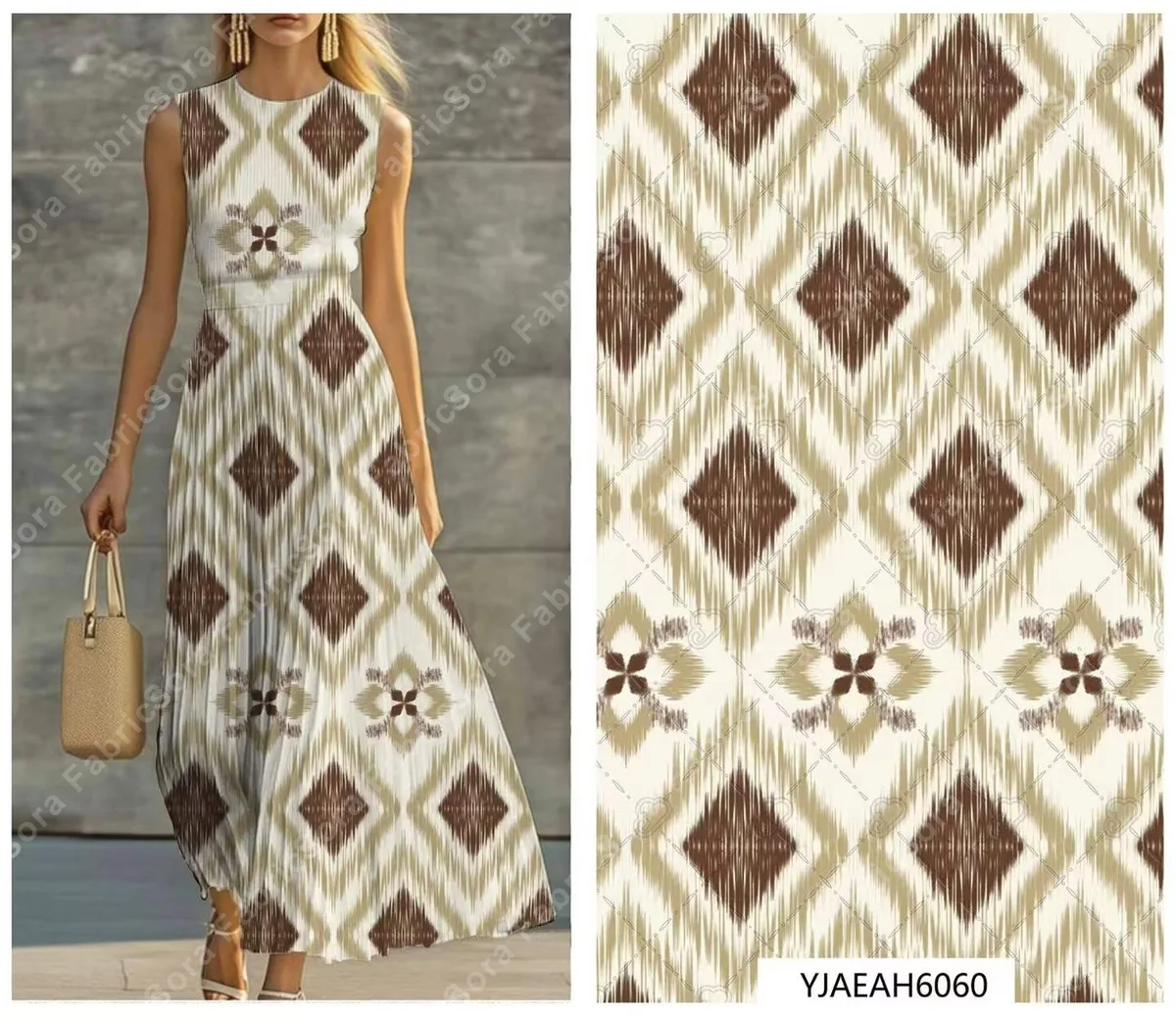
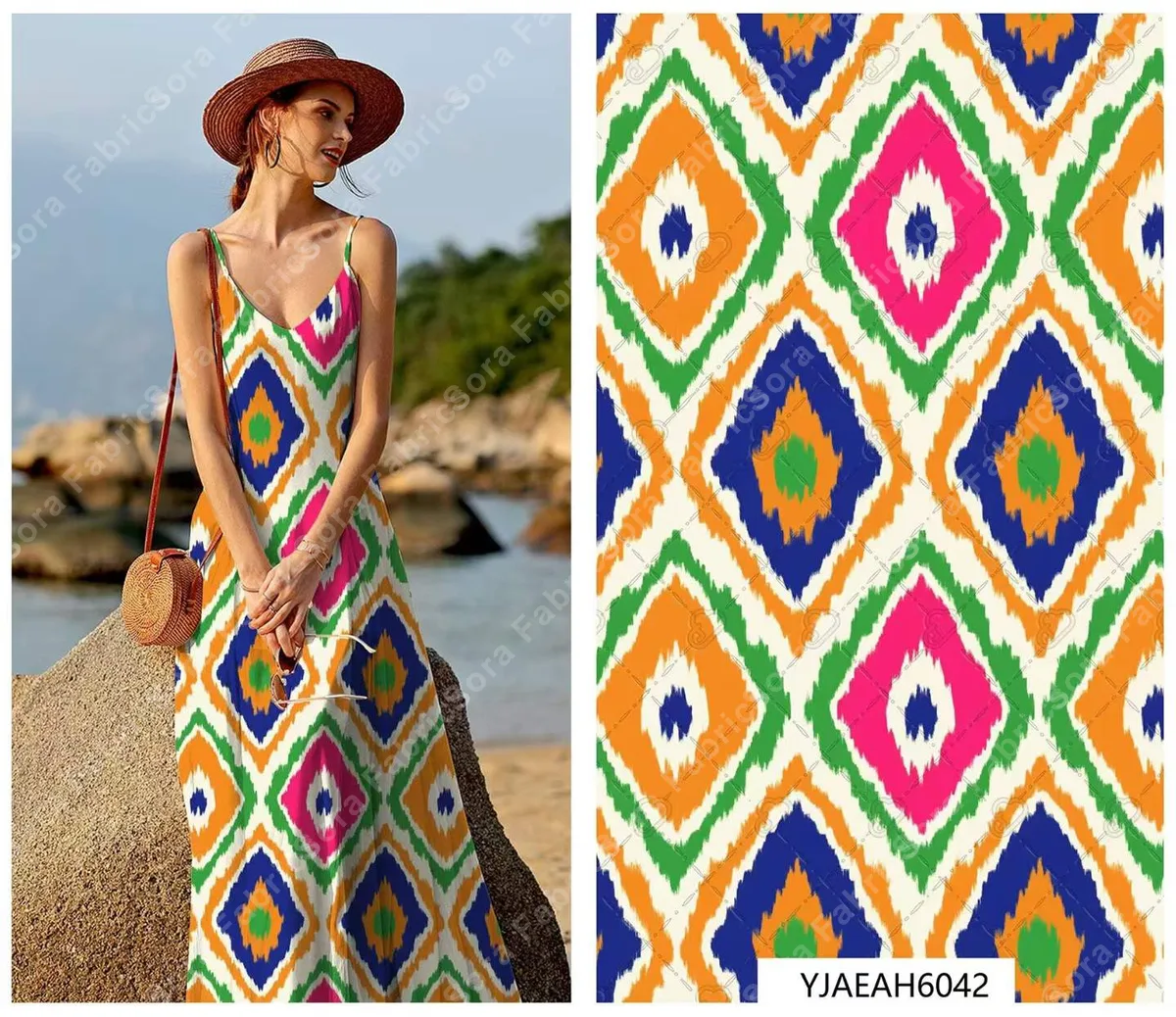
- Print clarity is higher on tight patterns — the heavier base supports finer line work (paisley, micro-floral, geometric grids) without the bleed you see on lightweight rayons.
- Watercolor and gradient effects are stunning — the slubby surface gives ink a textural anchor. Our top-selling watercolor florals are designed specifically for this base.
Bohemian-style placement prints land especially well: the heavier hand makes maxi-dress and kaftan silhouettes drape with body, while still being printable at the 150 m MOQ that lets indie brands launch.
A concrete scenario: 300-meter Mediterranean resort capsule
Picture a Spanish-Mediterranean indie brand designing a Spring resort capsule — wide-leg trousers, oversized blouses, midi dresses with a “summer in Mallorca” mood board. The brand specifies a “linen look” because customers expect it from the aesthetic, but the budget is $1.50-2.00/m maximum delivered.
Working with us, the line plan becomes:
- 2 prints × 150 m of tencel-linen blend at $1.20/m = $360
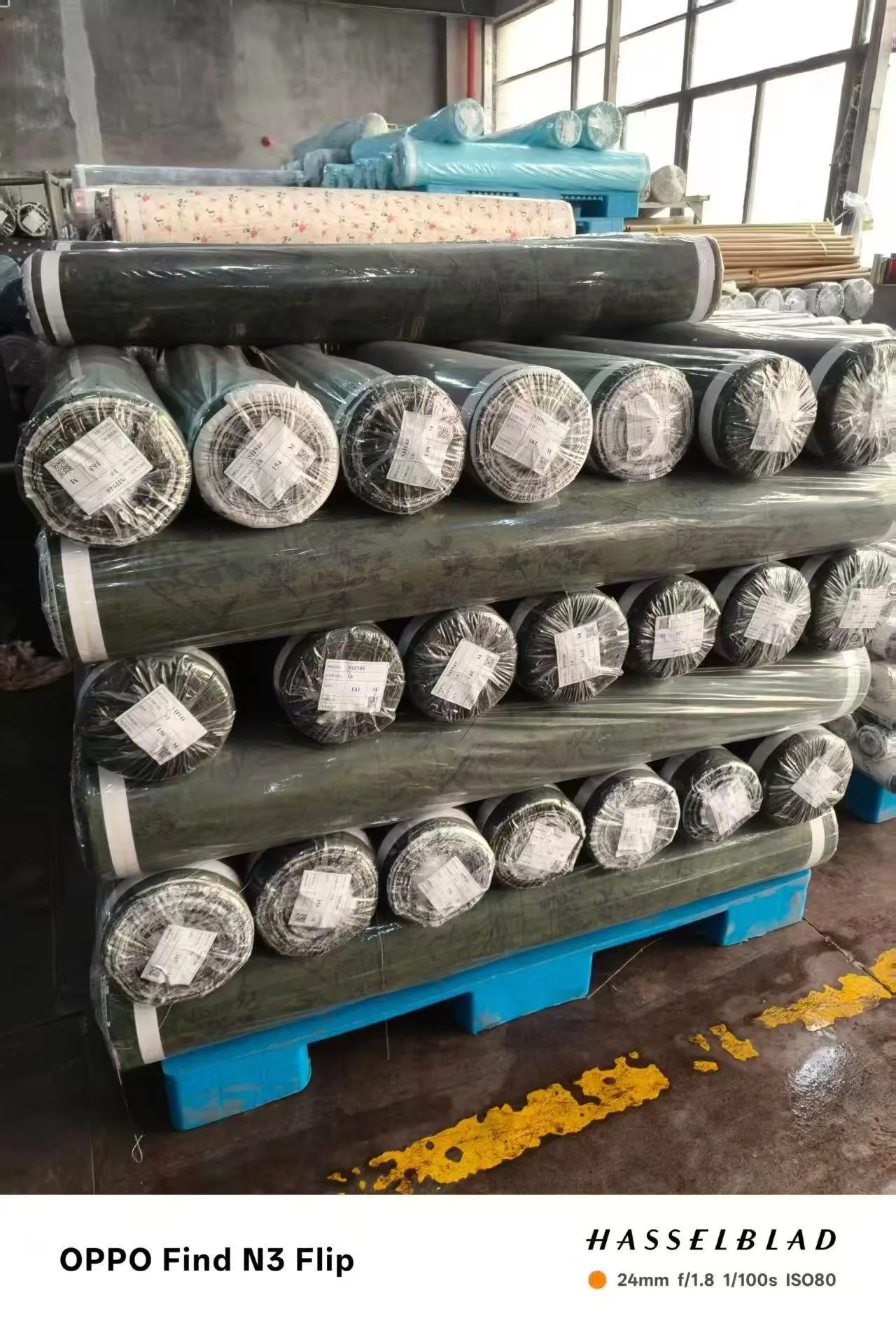
- 5-7 day dispatch from our ready stock
- Air freight from Guangzhou to Madrid runs $130-180 for ~36 kg
- Landed cost per meter: roughly $1.65-1.80 — a third of what 100% linen would have cost, with 85% of the visual finish
That’s the math that turns “wishlist fabric” into “production fabric” for a brand at the indie scale.
Tencel-Linen vs. its alternatives — quick comparison
If you are choosing between our tencel-linen blend and the adjacent fiber options:
| Base | GSM | Hand | Best for | MOQ |
|---|---|---|---|---|
| 100% Rayon (Viscose) | 90-100 | Smooth, fluid | Watercolor florals, kaftans, scarves | 150 m |
| Tencel-Linen blend (85/15) | 120-125 | Slubby, drapey | Resort wear, structured dresses, blouses | 150 m |
| Lyocell blend (70/30) | 100-110 | Silky, moisture-wicking | Active-resort, summer dresses | 100 m |
| 100% Cotton poplin | 100 | Crisp, breathable | Kids’ wear, classic prints | 50 m |
The decision usually narrows on GSM + drape: lighter dresses → rayon; structured pieces → tencel-linen; performance pieces → lyocell.
For the full base-by-base comparison see Rayon vs Viscose: Are They the Same Fiber? and What Does GSM Mean in Fabric?.
Sustainability note
Real tencel (TENCEL™ Lyocell) carries genuine sustainability certifications — Lenzing’s closed-loop solvent process recycles ~99% of process water and reduces emissions vs. conventional rayon. Our faux tencel-linen blend does not carry those certifications because the rayon base is conventionally produced. If your brand’s positioning depends on TENCEL™ certification, you need the real fiber — which means moving up to the 1,000+ m MOQ commitment and the price point that comes with it. For brands whose positioning is “linen aesthetic, accessible price” rather than “certified sustainable,” our blend is the production-cost-realistic answer.
Get a swatch
We hold 15+ tencel-linen prints in ready stock, plus custom artwork printing at 300 m MOQ. WhatsApp us at Sorafabrics — send a reference image and we’ll mail a swatch card of available prints the same day. Or browse the tencel-linen collection directly.